
Hi all,
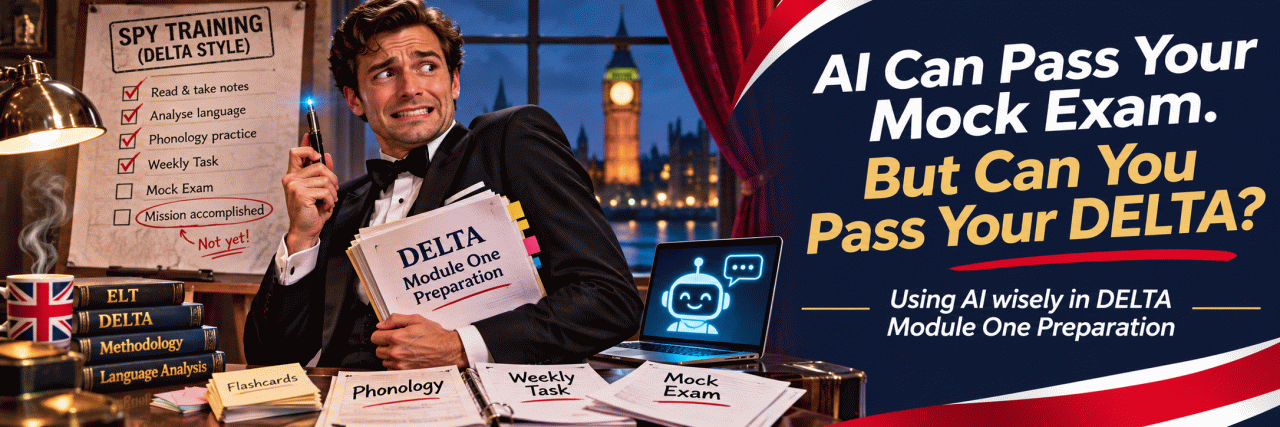
Imagine James Bond sending somebody else to complete all his training exercises, attend his firearms training, practise his driving skills and study his intelligence reports. Then, when M sends him on an actual mission, he turns up in a beautifully tailored suit with absolutely no idea what he's doing.
I suspect it would be a rather short film.
Unfortunately, something similar can happen when DELTA Module One candidates become excessively dependent on artificial intelligence during their preparation.
You receive your weekly task, copy the questions into ChatGPT, wait a few seconds, make some minor adjustments to the answers and submit them. Your tutor receives a beautifully written response demonstrating an impressive understanding of English language teaching, second language acquisition and linguistic analysis.
Lovely jubbly!
There's just one slightly inconvenient question: whose understanding is being demonstrated?
The Purpose of Your Weekly Tasks
Your weekly tasks on a DELTA Module One preparation course are not administrative obligations designed to keep you occupied until the examination. Nor are they opportunities to demonstrate your ability to produce an academically impressive Word document.
They're learning opportunities.
They're designed to help you develop your knowledge of ELT terminology, analyse language, evaluate teaching materials, understand assessment principles, explore methodological assumptions and become familiar with the demands of the examination.
More importantly, they help your tutors identify gaps in your knowledge and understanding.
When I receive a candidate's response containing inaccurate terminology, an incomplete language analysis or a misunderstanding of a methodological principle, I have something useful to work with. I can identify the problem, provide feedback and recommend further reading.
When artificial intelligence produces the entire answer on the candidate's behalf, that opportunity disappears.
Your tutor may end up assessing the competence of a language model rather than your developing competence as a DELTA candidate.
And, as far as I'm aware, ChatGPT hasn't paid the examination fees.
The Dangerous Illusion of Progress
One of the most problematic aspects of using AI to complete your weekly tasks is that it can create an illusion of learning.
You read an AI-generated explanation of the distinction between validity and reliability. It makes perfect sense. You recognise the terminology, understand the examples and submit the answer.
A week later, you're asked to explain the same concepts independently.
Suddenly, things become considerably less straightforward.
There's an important distinction between recognising information and retrieving it independently. Understanding an explanation when it's presented to you doesn't necessarily mean that you can reconstruct that explanation, apply the concept to an unfamiliar context or produce an accurate answer under examination conditions.
The DELTA Module One examination requires considerably more than recognising familiar terminology.
You need to retrieve knowledge, analyse unfamiliar material, make connections between concepts, select relevant information and formulate precise responses within strict time constraints.
These are abilities that develop through repeated practice.
You cannot outsource the practice and reasonably expect to retain all its benefits.
It's rather like watching somebody else spend an hour at the gym and expecting to develop their muscles.
If that worked, I'd have a considerably different physique by now.
Your Mock Exam Is Supposed to Expose Your Weaknesses
Of all the inappropriate uses of AI during DELTA Module One preparation, using it to answer mock examination questions is perhaps the most damaging.
A mock examination serves an important diagnostic function. It helps you establish how well you can perform independently under conditions that resemble those of the actual examination.
It reveals whether you can manage your time, retrieve terminology, interpret task requirements, analyse language accurately and produce sufficient relevant points.
If you're using AI during your mock examination, you're compromising the very purpose of the exercise.
Imagine achieving an excellent score in your mock examination and consequently deciding that you don't need to spend much more time studying phonology.
Unfortunately, the excellent phonological analysis was produced by ChatGPT.
Come examination day, you're sitting there trying to remember the difference between assimilation and elision while your extremely knowledgeable electronic colleague is nowhere to be seen.
Rather unfortunate.
A poor mock examination result obtained independently is considerably more valuable than an excellent result obtained with AI assistance.
The former tells you what you need to work on. The latter may give you confidence that you haven't actually earned.
And false confidence is a particularly expensive commodity when you're preparing for an international professional qualification.
Artificial Intelligence Can Get Things Wrong, Too
There's another issue worth considering.
AI-generated answers can be remarkably convincing even when they're inaccurate.
An AI tool might confuse a methodological approach with a teaching technique, misidentify a phonological feature, provide an inaccurate grammatical analysis or attribute a theoretical principle to the wrong scholar.
It might also produce an answer that is broadly accurate from an ELT perspective but insufficiently precise or relevant to the requirements of a particular DELTA examination task.
The language will probably be beautiful, though.
That's part of the problem. We tend to associate fluent, confident academic language with expertise. Unfortunately, fluency and factual accuracy are two rather different things.
As a DELTA candidate, you need to develop the professional knowledge necessary to evaluate what AI tells you.
If you don't yet understand a concept sufficiently well, how will you know whether the explanation you're receiving is accurate?
AI can be an excellent study companion, but I wouldn't appoint it as the final authority on applied linguistics just yet.
Am I Against Using AI?
Absolutely not.
I've been in the teaching profession since 2001, and I've witnessed considerable changes in the technology available to teachers and learners. Artificial intelligence is undoubtedly one of the most interesting developments we've seen.
It would be rather contradictory for a teacher educator to encourage innovation while insisting that teachers ignore such a potentially useful resource.
The problem isn't artificial intelligence itself. It's the way we choose to use it.
There's a fundamental difference between using AI to support your thinking and using AI to replace your thinking.
The former can contribute to professional development. The latter can seriously undermine it.
So, how can DELTA Module One candidates use AI productively?
1. Use AI as a Personal Tutor
Suppose you've been reading about the difference between declarative and procedural knowledge, but you're still struggling to understand the distinction.
Rather than asking AI to answer your weekly task, ask it to explain the concepts using practical classroom examples.
You might use a prompt such as:
Explain the difference between declarative and procedural knowledge to a DELTA Module One candidate. Provide examples from English language learning, then ask me questions to check my understanding. Do not provide the answers until I have attempted them.
This encourages interaction, retrieval and reflection.
You're using AI to help you understand something rather than asking it to demonstrate understanding on your behalf.
2. Ask AI to Test Your Knowledge
One particularly useful application of AI is generating retrieval practice activities.
Ask it to test your knowledge of ELT terminology, grammatical features, phonology, assessment principles or language acquisition theories.
For example:
Test my knowledge of phonology using ten questions appropriate for DELTA Module One preparation. Present one question at a time, wait for my answer and provide constructive feedback before moving on.
You can even ask it to revisit concepts you've answered incorrectly.
The important thing is that you're producing the answers.
Your brain is doing the work, which is rather the point of the whole exercise.
3. Use AI to Explore Difficult Reading
DELTA reading can occasionally be a different kettle of fish.
You begin reading a chapter with admirable enthusiasm. Twenty minutes later, you've read the same paragraph four times and are beginning to question several of your life choices.
AI can help make challenging academic concepts more accessible.
You can ask it to explain a difficult passage, illustrate a theoretical principle, compare two approaches or generate classroom examples.
However, don't allow AI summaries to become a complete replacement for your professional reading.
Academic texts often contain qualifications, contrasting perspectives and contextual considerations that disappear when they're reduced to five bullet points.
Read the original material, use AI to clarify difficulties and return to the source with a better understanding.
You should also verify quotations, references and theoretical claims against reliable publications. An impressive-looking reference is not necessarily a real one.
4. Use AI to Challenge Your Thinking
Instead of asking AI to agree with you, ask it to challenge you.
Suppose you've written an explanation of why a particular speaking activity might be useful for developing fluency.
Ask AI to identify weaknesses in your reasoning, suggest alternative interpretations or question your assumptions.
For example:
Act as a critical ELT study partner. Challenge my analysis by asking questions about my reasoning, terminology and supporting evidence. Do not rewrite my answer or provide a model answer.
This kind of interaction can help you become a more reflective practitioner.
It also encourages you to defend your ideas, reconsider your assumptions and refine your professional understanding.
These are valuable skills well beyond the DELTA examination.
5. Attempt the Task First, Consult AI Afterwards
For independent study activities where AI assistance is permitted, I'd recommend establishing a simple rule:
My brain first. Artificial intelligence second.
Attempt the task independently. Struggle with it. Consult your reading where appropriate. Retrieve what you can remember and formulate your own response.
Once you've completed your independent attempt, you can use AI to explore areas of uncertainty or identify possible gaps in your understanding.
For submitted weekly tasks and mock examinations, follow your course's instructions and preserve your original, independent answers for tutor assessment. Ideally, use AI for further learning after submission and feedback rather than allowing it to influence the work being assessed.
Never underestimate the educational value of struggling with a difficult question.
Sometimes that uncomfortable period of trying to remember, analyse and organise information is precisely where learning takes place.
Removing every intellectual difficulty from your preparation may make your evenings more pleasant, but it won't necessarily make your examination performance any better.
6. Use AI to Develop a Personalised Revision Programme
AI can also be useful in helping you organise your preparation.
After receiving feedback from your tutors, identify your recurring weaknesses and ask AI to help you develop a revision schedule.
For instance:
My main weaknesses are phonological analysis, testing terminology and identifying the assumptions underlying teaching materials. Create a two-week revision programme incorporating retrieval practice, spaced revision and independent examination-style activities.
This is a sensible use of technology because it's helping you organise your learning rather than completing it for you.
You can also use it to generate flashcards, supplementary practice questions and revision activities, provided that you check their accuracy against your course materials and recommended reading.
A Simple Traffic Light System for AI Use
Here's how I would categorise different uses of AI during DELTA Module One preparation.
GREEN — Productive use
Clarifying difficult concepts.
Generating additional practice questions.
Testing your knowledge interactively.
Organising your revision schedule.
Exploring examples of linguistic features.
Challenging your understanding of ELT concepts.
AMBER — Use with caution
Summarising academic reading.
Evaluating independently completed practice answers.
Generating model answers for comparison after completing a task.
Providing theoretical explanations and academic references.
Suggesting examination techniques.
These applications can be useful, but they require independent verification, critical judgement and compliance with your course's assessment instructions.
RED — Counterproductive use
Asking AI to complete your weekly tasks.
Submitting AI-generated answers as your own.
Using AI during mock examinations intended to assess independent performance.
Paraphrasing AI-generated responses to disguise their origin.
Replacing professional reading entirely with AI summaries.
Memorising AI-generated model answers without understanding them.
The distinction isn't particularly complicated. Ask yourself whether the technology is helping you develop an ability or performing that ability on your behalf.
Your Tutor Is Not the Person You Need to Impress
I sometimes wonder whether candidates become so concerned about demonstrating competence to their tutors that they forget why they're attending a preparation course in the first place.
You don't need to convince your tutor that you already know everything.
If you did, there wouldn't be much point in attending the course.
Your tutor needs to see your mistakes, misunderstandings and uncertainties. These are essential sources of information that inform feedback and support your professional development.
Submitting an immaculate AI-generated response might conceal your weaknesses temporarily, but it does absolutely nothing to resolve them.
Besides, your tutor isn't going to sit the examination on your behalf.
Neither is ChatGPT.
A Final Thought
The DELTA is not simply a qualification to add to your CV, your LinkedIn profile or the rather impressive collection of abbreviations following your name.
It's an opportunity to develop a deeper understanding of language, learning and teaching.
The knowledge you acquire during your preparation should remain useful long after you've received your examination result.
By all means, embrace artificial intelligence. Experiment with it. Ask it questions. Challenge it. Use it to explore concepts, organise your learning and test your knowledge.
But don't surrender your intellectual responsibilities to it.
When examination day arrives, there will be no prompt engineering, no opportunity to regenerate a response and no electronic assistant producing a beautifully formatted explanation of the underlying assumptions of a coursebook activity.
There will be you, the examination questions and the knowledge you've genuinely acquired.
Make sure you've spent your preparation developing the competence of the person who will actually be sitting the examination.
Q Branch can provide James Bond with all the gadgets in the world, but Bond still has to complete the mission himself.
Use AI as your training partner, not your substitute.
You know it makes sense.
Happy studying!
Shady R. Abuyusuf
Comments
0No comments yet. Be the first to join the discussion.