
Hi all,
There's one CELTA criterion that candidates read, nod at, and then quietly forget about by TP3: teaching a class with an awareness of the needs and interests of the learner group. It sounds obvious. Of course you're aware of your learners, they're sitting right in front of you! But your tutors aren't asking whether you can see them. They're asking whether what you know about them actually changes what you do.
Whether I'm tutoring a CELTA in Cairo or in Durban, the candidates who do well here are the ones who treat their TP group like real people with real lives, not as "the students" in a lesson plan. So here's how to do it, in three moves.
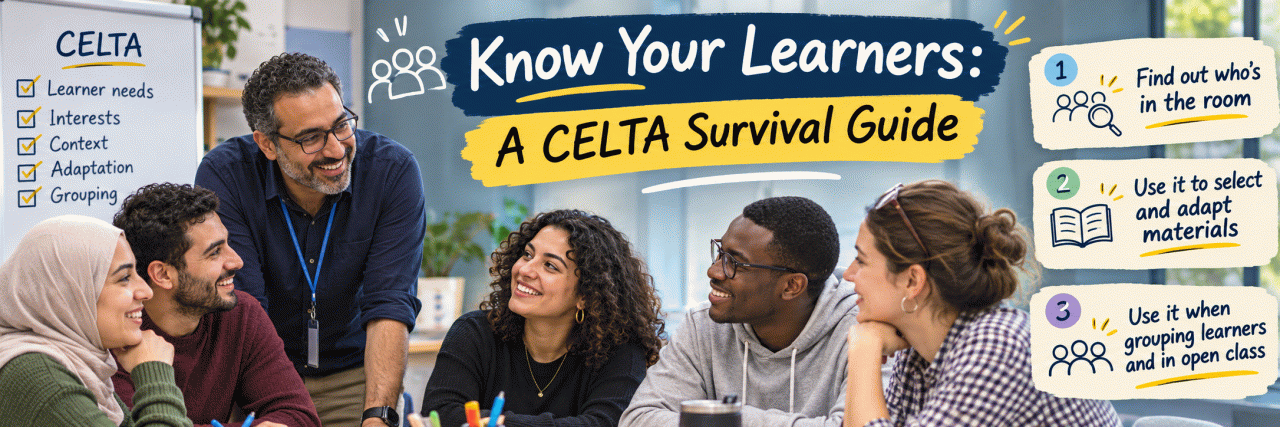
1. Find out who's in the room
Think of this as intelligence gathering. Your mission, should you choose to accept it: learn enough about your group that you could plan a lesson for them, not for any B1 class anywhere in the world.
Ask the learners. You don't need a 40-question survey. A few quick ways in:
- A short getting-to-know-you activity in your first TP (find someone who…, two truths and a lie, a quick "me in five pictures").
- A mini questionnaire: Why are you learning English? Where do you use it? What do you find hardest?
- Questions during the lesson itself: "Has anyone here ever…?" "Who uses English at work?"
- Listening while you monitor. Learners tell you loads about themselves during pair work if you're paying attention.
Ask your peers. This is the bit people forget. Your TP group has been taught by everyone on your course, so your colleagues are a goldmine. Who's quiet? Who finishes early? Who loves talking about football? Who struggles with past forms? Read the TP points and feedback from previous lessons, and actually watch your peers' lessons with your learners in mind, not just your peers.
Write it down. Keep a simple learner profile, a page in your notebook or a shared doc for your TP group: names, jobs or studies, interests, strengths, common errors, and who works well (or not so well) together. Then put the relevant bits into your lesson plan's learner profile and anticipated problems. If it's only in your head, your tutor can't see it.
2. Use it to select and adapt materials
The coursebook is a starting point, not a script. Once you know your group, ask yourself: Will this work for these people?
Some simple adaptations that make a big difference:
- Personalise the lead-in. Instead of "Look at the picture. What can you see?", connect the topic to their lives: "Who here takes the metro to work? What's the worst thing about it?"
- Swap examples and contexts. If the book's grammar examples are about someone's ski holiday in Switzerland, use a context your learners know: their city, their jobs, their weekends. Use their names (kindly!) in example sentences. They'll pay attention, I promise.
- Replace or tweak a text or topic that clearly won't land. A text about pensions might not grab a class of university students; something about job interviews might.
- Adjust the task to the group. Add an easier first question for a weaker group, an extension task for your fast finishers, or more preparation time before speaking for a group that freezes up.
- Choose activity types they respond to. Some groups love getting up and mingling; others need to write ideas down before they speak. Some love a competitive game; some prefer a calmer discussion. You'll only know if you've found out (see section 1).
Notice the words where appropriate in the criterion, though. You don't need to rewrite the whole unit. Keep your aims clear, and adapt where it genuinely helps learning. Then say why in your plan: "I changed the reading topic because most learners are engineers and showed little interest in…" One honest sentence like that is worth more than a page of generic rationale.
3. Use it when grouping learners and in open class
This is where your learner knowledge really shows up in the room.
Setting up pairs and groups. Don't just say "work with the person next to you" every time. Think about:
- Level: Do you want a stronger learner to support a weaker one, or similar levels so both get a real challenge? It depends on the task.
- Personality: Split up the two friends who chat in L1 the whole time. Don't put two very quiet learners together for a speaking task. Give a dominant learner a role (timekeeper, secretary, reporter) so others get space.
- Variety: Change pairs during the lesson. It keeps energy up and stops learners getting stuck with the same partner all course.
Dealing with learners in open class. Use what you know, warmly and naturally:
- Use names. Every time.
- Refer back to what learners have told you: "Mona, you said you work in a hotel. Do guests complain a lot?" It shows you listen, and it makes the language real.
- Nominate sensibly. Give a shy learner an easier question first, or let them check with a partner before answering in front of everyone. Save the stretching questions for those who are ready for them.
- Be sensitive. Some topics are personal, and not everyone wants to share their family situation or salary with the class. Knowing your learners also means knowing what not to ask.
A quick checklist before you teach
- Do I know something real about each learner in my group?
- Have I asked my peers what they've noticed?
- Is there at least one moment in my lesson that connects to their lives?
- Have I adapted anything from the book, and said why in my plan?
- Have I thought about who works with whom, and why?
- Do I know who needs a gentle question and who needs a challenge?
If you can tick most of those, you're showing exactly the awareness your tutors are looking for. And honestly, your lessons will just be better. Learners notice when a teacher has bothered to get to know them, and they work harder for that teacher.
Good luck with your TPs, and remember: he who dares… wins!
Cheers,
Shady Abuyusuf
Comments
0No comments yet. Be the first to join the discussion.