
The Million-Dollar Question: How Do I Get a Pass A?
Having worked as a CELTA tutor for years, I've noticed something rather interesting about candidates. Some arrive with a genuine curiosity about teaching, a willingness to experiment, and an eagerness to learn. Others arrive with one burning question:
"Shady, how can I get a Pass A?"
Not "How can I become a better teacher?" Not "How can I help my students learn more effectively?" Not even "How do I survive teaching practice without having a nervous breakdown?"
No. Straight to the Pass A.
My usual response is slightly cheeky:
"In my experience, the candidates who spend the most time asking how to get a Pass A or Pass B are often the very ones who don't get them!"
Of course, I'm exaggerating to make a point. There's absolutely nothing wrong with being ambitious or wanting to achieve the highest possible grade. In fact, I admire ambition.
The problem begins when the grade becomes more important than the learning.
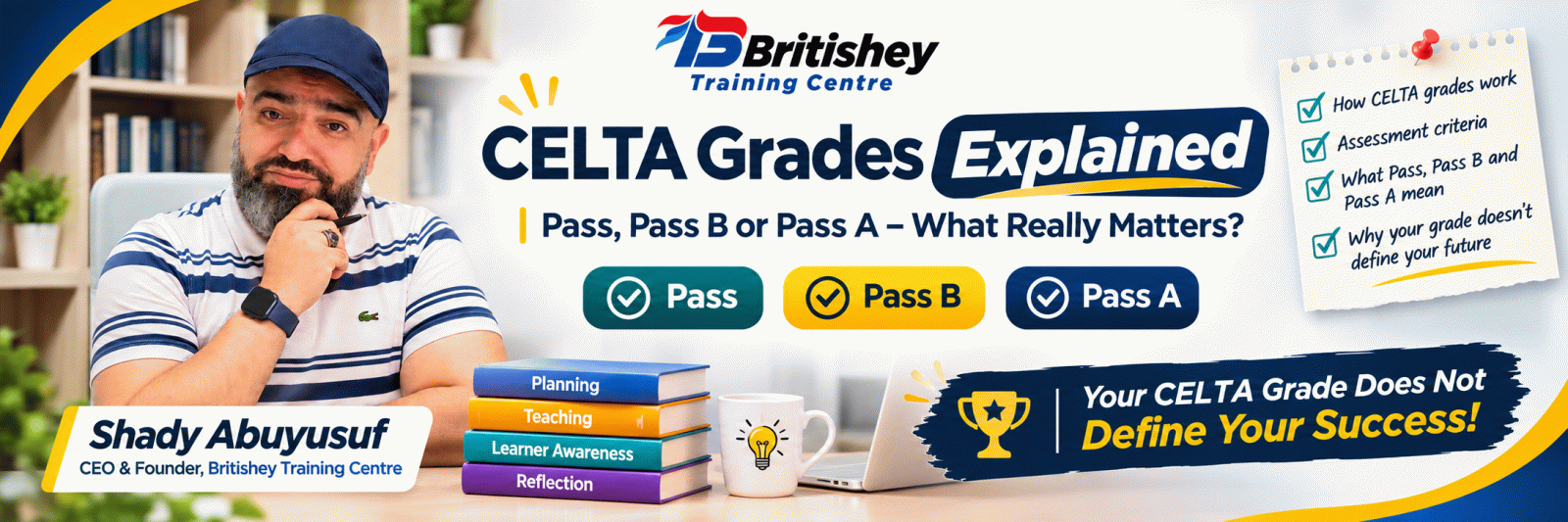
And that's precisely what I want to discuss today: how CELTA grades actually work, what Cambridge looks for, and why the letter printed on your certificate is not a prediction of your future success as an English language teacher.
First, Let's Understand How CELTA Assessment Actually Works
One of the most common misconceptions about CELTA is that candidates collect marks throughout the course and that these marks are somehow added together to produce a final grade.
That's not how it works.
According to Cambridge's CELTA assessment guidelines, assessment is continuous, integrated and holistic.
In simple terms, you're assessed throughout the course, and tutors consider your development and overall performance against the assessment criteria rather than calculating a mathematical average of your individual lesson grades.
There are two main assessed components.
1. Teaching Practice (TP)
Candidates complete six hours of assessed teaching practice, teaching learners at two different levels.
Tutors assess areas such as lesson planning, language analysis, classroom management, teaching techniques, awareness of learners, responsiveness to learners' needs, and the ability to reflect on teaching.
Importantly, tutors consider your progress throughout the course, the consistency of your performance, and how independently you can plan and teach as the course progresses.
2. Written Assignments
Candidates complete four written assignments covering different areas of language teaching, including learners, language analysis, language skills, and reflection on classroom practice.
Written assignments are assessed on a Pass/Fail basis. They do not receive Pass A or Pass B grades.
Candidates must also meet the relevant course requirements, including attendance, observation of experienced teachers, and maintaining their assessment portfolio.
So, no, there isn't a mysterious Excel spreadsheet somewhere calculating your final grade to three decimal places.
And no, delivering one excellent lesson does not automatically earn you a Pass A.
Equally importantly, delivering one disappointing lesson does not automatically destroy your chances of achieving a higher grade.
So, What's the Difference Between Pass, Pass B and Pass A?
Cambridge's CELTA performance descriptors provide a clear explanation of the standards expected for each passing grade.
These grades reflect demonstrated teaching competence within the context of an initial teacher-training qualification, not some universal ranking of every English teacher on the planet.
Pass: A Solid Foundation for Your Teaching Career
A Pass means that you have met the required CELTA assessment criteria and demonstrated satisfactory understanding of English language teaching and learning processes.
By the end of the course, you can generally deliver effective lessons, plan appropriately with guidance, demonstrate awareness of learners, and reflect on important strengths and weaknesses in your teaching.
In other words, you've developed the essential foundations needed to begin your professional teaching journey.
And that's an achievement worth celebrating.
A Pass is not a consolation prize. It's a recognised Cambridge teaching qualification demonstrating that you've successfully met the required standard.
Pass B: Good Performance and Growing Independence
A Pass B reflects a stronger overall standard of performance.
Candidates achieving Pass B demonstrate good understanding of language teaching and learning processes, analyse target language well, select appropriate materials and tasks, and deliver effective lessons using a range of classroom techniques.
They also demonstrate good awareness of learners and use reflection to develop their teaching.
A significant feature is their ability to plan effectively with some guidance, demonstrating increasing professional independence.
Pass A: Excellent Performance and Greater Autonomy
A Pass A recognises excellent performance against the CELTA assessment descriptors.
Candidates achieving Pass A demonstrate excellent understanding of teaching and learning processes at CELTA level.
They can plan effectively with minimal guidance, analyse target language thoroughly, select appropriate resources and tasks, teach effectively, and demonstrate very good awareness of learners.
They also consistently use reflection to develop their teaching skills.
Notice something important here?
The difference is not simply how confident, charismatic or entertaining you are in the classroom.
It's about meeting the relevant descriptors across planning, teaching, learner awareness, reflection and overall professional understanding.
Cambridge specifies that candidates must meet all the descriptors for a particular passing grade to achieve it.
That's why a candidate who delivers an absolutely brilliant speaking lesson but consistently struggles with planning or language analysis cannot automatically expect a Pass A.
CELTA assesses more than your ability to put on a good show.
One Bad Lesson Is Not the End of the World
Now, here's something I particularly want CELTA candidates to understand.
Cambridge's assessment guidance explicitly recognises that weak lessons early in the course do not count against candidates if sufficient progress is subsequently demonstrated.
Read that again.
You are allowed to make mistakes. You are expected to learn. And your development matters.
Imagine two candidates.
Candidate A delivers a disappointing lesson. The instructions are unclear, the timing goes horribly wrong, and the students spend ten minutes wondering what they're supposed to be doing.
Not exactly the finest moment in educational history.
After receiving feedback, Candidate A identifies the problems, reflects on their causes, seeks clarification where necessary, and makes significant improvements in subsequent lessons.
Candidate B experiences a similar lesson. However, instead of concentrating on the feedback, they spend the next three days worrying that their chances of getting a Pass A have disappeared.
They compare their lesson assessment with everyone else's, analyse every word their tutor said, and practically conduct a forensic investigation into the feedback sheet.
Meanwhile, the actual learning points are sitting there, quietly waiting to be noticed.
Which candidate is making better use of the CELTA experience?
I think the answer is fairly obvious.
This is why excessive grade fixation can become counterproductive. It shifts your attention away from the very thing that could improve your performance: learning from feedback and applying it.
The Problem with Grade Fixation
I've seen candidates who are extremely intelligent, highly motivated, and genuinely capable of becoming excellent teachers become unnecessarily anxious because of their obsession with grades.
Every teaching practice session becomes a high-stakes examination.
Every tutor comment becomes a potential threat.
Every developmental point becomes evidence that their dream of obtaining a Pass A is slipping away.
And suddenly, instead of experimenting with teaching techniques, they're playing it safe.
Instead of reflecting honestly, they're trying to prove that their lesson was better than the feedback suggests.
Instead of asking, "What can I learn from this?" they're asking, "Will this affect my final grade?"
That's when the trouble starts.
Effective teacher development requires a willingness to make mistakes, reconsider assumptions, test new approaches, and sometimes admit that something simply didn't work.
If you're constantly worried about protecting a particular grade, you may become reluctant to take the very developmental steps that would make you a better teacher.
And there's another important issue.
Reflection is itself part of the CELTA assessment criteria.
Cambridge expects candidates to recognise strengths and weaknesses and use those reflections to improve their teaching.
At Pass A level, candidates are expected to do this consistently.
So, rather ironically, becoming obsessed with a Pass A can distract you from demonstrating one of the very qualities needed to achieve it.
Quite the plot twist, isn't it?
Your CELTA Grade Is Not a Crystal Ball
Let's address another misconception.
Does getting a Pass A mean you'll become an outstanding teacher?
Not necessarily.
Does getting a Pass mean you'll never become an outstanding teacher?
Absolutely not.
A CELTA grade tells us something meaningful about your demonstrated performance during an initial teacher-training course.
It does not tell us everything about your future professional development.
Remember that CELTA involves six hours of assessed teaching practice. Those six hours provide valuable evidence of your abilities at that particular stage of your training.
But your teaching career may continue for another 10, 20, 30 or even 40 years.
Think about how much you can learn during that time.
You might teach hundreds of classes, work with thousands of learners, develop expertise in different teaching contexts, become a teacher trainer, specialise in assessment or materials development, or pursue further qualifications such as DELTA.
Your professional identity will continue to evolve.
A teacher who receives a Pass but spends the next five years actively developing their skills may become considerably more effective than a teacher who receives a Pass A and then stops investing in professional development.
This is not an argument against achieving a Pass A. It's an argument against assuming that a high grade guarantees long-term excellence.
It doesn't.
Likewise, a Pass doesn't impose a ceiling on your professional potential.
Of course, grades may sometimes influence initial recruitment decisions, particularly when employers are comparing newly qualified teachers. We shouldn't pretend otherwise.
But once you're in the classroom, your sustained professional performance, your ability to help learners progress, and your commitment to continued development become enormously important.
Your CELTA grade describes your achievement at the end of a course. It doesn't determine who you're capable of becoming.
What Happens After CELTA Matters Even More
One of the things I've always tried to emphasise to candidates at Britishey Training Centre is that CELTA should be viewed as the beginning of a professional journey rather than its final destination.
Completing CELTA gives you a valuable foundation.
But a foundation, however strong, is not the entire building.
After the course, your development depends considerably on what you choose to do with what you've learned.
Do you continue reflecting on your lessons?
Do you read about language acquisition and teaching methodology?
Do you experiment with different approaches and evaluate their effectiveness?
Do you seek feedback from experienced colleagues?
Do you attend workshops, observe other teachers, or pursue additional professional qualifications?
Or do you simply put your CELTA certificate in a lovely frame, hang it on the wall, and announce that your professional development is officially complete?
If you've chosen the last option, I have some rather disappointing news.
CELTA is not a magical transformation ceremony. You don't enter the course as an ordinary human being and emerge four or ten weeks later as the undisputed master of English language teaching.
You graduate with knowledge, practical experience, new skills, and, hopefully, a much better understanding of how complex teaching really is.
What happens next is largely up to you.
My Advice to CELTA Candidates: Chase Development, Not Letters
If you're currently taking CELTA, or preparing to start, I'd encourage you to approach the experience with a slightly different mindset.
Instead of asking how to obtain a Pass A, ask how to become more effective at planning lessons independently.
Instead of worrying that one disappointing lesson has ruined your chances, identify the specific areas you need to improve.
Instead of comparing your progress with that of other candidates, compare your current teaching with your own performance at the beginning of the course.
And when your tutor offers developmental feedback, resist the temptation to interpret every comment as an indication of your final grade.
Your tutor isn't giving you feedback to spoil your afternoon.
They're giving you feedback because there's something valuable you can learn from it.
Take that opportunity seriously.
Be ambitious, certainly. Aim for excellence. Work hard. Read widely. Prepare carefully.
But allow yourself to make mistakes.
Allow yourself to be challenged.
Most importantly, allow yourself to learn.
Because if you concentrate on consistently improving your teaching, you'll be working towards the very qualities that higher CELTA grades are intended to recognise.
And even if you finish with a Pass rather than a Pass A, the professional growth you've achieved will still be valuable.
A Final Word from Me
Over the years, I've become increasingly convinced that one of the healthiest attitudes a CELTA candidate can adopt is this:
"I want to become the best teacher I can be. The grade will reflect the standard I demonstrate during the course, but it won't define my future."
If you receive a Pass A, congratulations! You've demonstrated excellent performance at CELTA level, and you should be proud.
If you receive a Pass B, congratulations! You've demonstrated good performance and developed a strong foundation for further growth.
And if you receive a Pass, congratulations! You've successfully met the requirements of a demanding and internationally respected initial teacher-training qualification.
Whichever passing grade you achieve, celebrate it.
Then get back to learning.
Because ten years from now, your students are unlikely to care whether you received a Pass, Pass B or Pass A.
They'll care whether you can explain something clearly, create meaningful learning opportunities, respond to their needs, and help them make genuine progress.
They won't walk into your classroom and say, "Excuse me, teacher, before we start today's lesson, could you please confirm your CELTA grade?"
And if they do, you've certainly got an interesting class on your hands.
So, by all means, aim for a Pass A. Just don't become so obsessed with getting one that you forget why you enrolled on CELTA in the first place.
After all, the ultimate goal isn't to become a Pass A candidate.
It's to become an excellent teacher.
And that journey doesn't end when Cambridge issues your certificate.
In many ways, that's when it really begins.
Comments
0No comments yet. Be the first to join the discussion.