
Hi everyone,
Here's a confession from a CELTA tutor: some of the best lessons I've watched weren't the ones with the fanciest slides. They were the ones where the teacher said less, said it clearly, and then got out of the way.
On the CELTA, this comes under adjusting your own language to the learner group and the context. Tutors often call it grading your language. It sounds technical, but the idea is simple. The way you speak to a Pre-intermediate group of teenagers shouldn't be the same as the way you speak to an Advanced group of business professionals. And neither should sound like you're reading out the terms and conditions of a mobile phone contract.
In this post, we'll look at three things your tutors will be watching for in TP:
- Using comprehensible language to give instructions and explain things
- Keeping your simplified language natural
- Keeping teacher talk at an appropriate level, so your learners get the chance to speak
Your mission, should you choose to accept it, starts now.
1. Make your instructions and explanations easy to follow
If your learners don't understand the instructions, the task fails before it starts. You'll see it straight away: confused faces, someone asking their partner "What do we do?", and one brave student writing on the wrong page.
Compare these two:
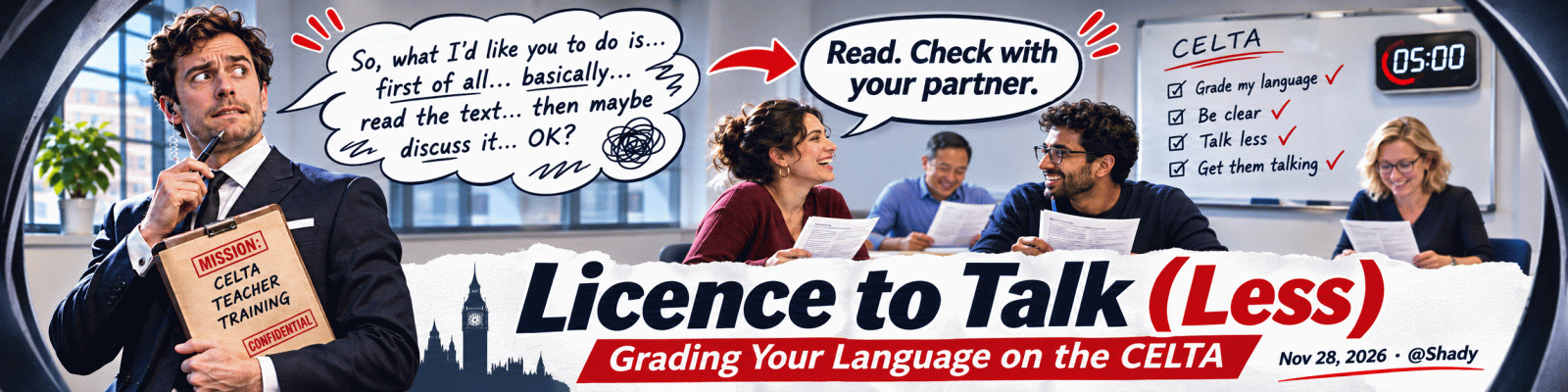
Version A: "Okay, so what I'd like you to do now, if you don't mind, is to have a look at the text on page 42, and while you're reading it, try to think about whether the writer would agree with the statements below, and then maybe discuss it with the person next to you."
Version B: "Page 42. Read the text. Are sentences 1 to 5 true or false? You have three minutes. Work alone."
Version A is polite and friendly, but it's a maze. Version B gives learners exactly what they need, in the order they need it.
A few tips for clear instructions:
- Plan them. Write your key instructions in your lesson plan, word for word. It feels odd at first, but it saves you from improvising a 60-word sentence on the spot.
- Use short sentences and imperatives: "Read", "Write", "Check with your partner".
- Give one step at a time, in the order learners will do it.
- Show, don't just tell. Hold up the handout, point to the exercise, do the first example together.
- Hand out materials after the instructions, not before. Otherwise everyone's reading the handout instead of listening to you.
- Check understanding with ICQs (instruction checking questions): "Are you writing or speaking?" "Alone or in pairs?" "How many minutes?" Avoid "Do you understand?" Everyone says yes. Nobody means it.
The same goes for explanations. When you clarify meaning, grade your language to the level of the group:
- Use words learners already know to explain new ones. Defining reluctant as "unwilling and hesitant" to a Pre-intermediate group just gives them two new words.
- Lean on examples, pictures, timelines, mime and context rather than long definitions.
- Follow up with CCQs to check they've really got it.
2. Simplify, but keep it natural
Here's the trap many CELTA candidates fall into. Once they learn to grade their language, they go too far and start speaking like a robot from a 1970s film:
"YOU. READ. TEXT. NOW. YES?"
It's simple, but it isn't English anyone actually speaks. And remember, your learners are listening to you all lesson. You're one of their best sources of real, natural English. If you model broken English, that's what they'll pick up.
So the aim is simple and natural, not simple and strange.
Unnatural (over-simplified)
Natural and graded
"You work with partner. You speak."
"Work with your partner. Talk about your weekend."
"Finish? Finish? Yes? Finish?"
"Have you finished? Okay, great."
"This word: big, big, very big."
"Huge means very, very big. An elephant is huge."
"Teacher give paper. You write."
"I'll give you a worksheet. Write your answers here."
How to keep it natural:
- Keep the grammar intact. Use articles, auxiliaries and normal word order. Shorter sentences, yes. Broken sentences, no.
- Speak at a natural speed, with natural stress and intonation. Slowing down a little is fine. Stretching every word like chewing gum isn't.
- Don't shout. Being louder doesn't make you clearer, although I've seen it tried many times.
- Use common, high-frequency words, but use them the way an English speaker would.
- Adjust to the level, not to an imaginary lowest level. An Upper-intermediate group can cope with "Have a quick chat with your partner about it." A Beginner group might need "Talk to your partner." Both are natural English.
Think of it as turning the volume down on complexity, not switching off the music.
3. Talk less, so they can talk more
Your learners came to improve their English, not to listen to yours for 45 minutes. Every minute you spend talking is a minute they're not practising.
This doesn't mean teacher talk is bad. Learners need your input, your examples, your feedback and your stories. The question is whether your talk is purposeful and at the right amount for that stage of the lesson. A clarification stage will naturally have more teacher talk than a fluency task. What tutors don't want to see is the teacher filling every silence.
Common TTT habits to watch out for:
- Echoing. A learner says "I went to Alexandria." You say "You went to Alexandria!" It's a reflex, and the class soon learns to wait for your version instead of listening to each other.
- Answering your own questions. You ask, wait one second, then answer it yourself. Give them time. Silence after a question means thinking, not failure.
- Over-explaining. If the instruction worked, you don't need to say it three more times.
- Running commentary. "Okay, so now I'm just going to put this up here, and then we'll..." Learners don't need the director's cut.
- Jumping in during speaking tasks. Monitor, listen, take notes, and save your feedback for later.
Ways to give learners more speaking time:
- Elicit instead of telling. Ask questions so learners produce the language: "What's this?" "What did she do yesterday?"
- Use pair and group work, so many learners speak at once, not one at a time.
- Nominate and redirect. "Ahmed, what do you think? Do you agree, Mona?" Let learners respond to each other.
- Let peers check answers first before open class feedback.
- Use gestures for routine messages. A hand to the ear, a thumbs-up or a pointing finger can replace a whole sentence.
- Record yourself in one lesson (with permission) and listen back. It's painful, I know. It's also the fastest way to notice your habits.
Like Kung Fu, this takes practice. Nobody walks into their first TP with perfect teacher talk. You notice one habit, work on it, then move to the next.
Your pre-TP checklist
Before your next teaching practice, run through these:
- Have I scripted my key instructions in the plan?
- Are my instructions short, staged and in the right order?
- Have I planned ICQs for each task?
- Can I explain new language using words the group already knows?
- Is my simplified language still natural, grammatical English?
- Where can I elicit instead of telling?
- Which stages should have the least teacher talk, and how will I step back?
Grading your language is one of those skills that separates a teacher who knows English from a teacher who can teach it. Get it right, and your learners understand you, trust you and, best of all, talk more than you do.
He who dares... grades! Good luck with your next TP.
Shady R. Abuyusuf
Comments
0No comments yet. Be the first to join the discussion.