
Hi all,
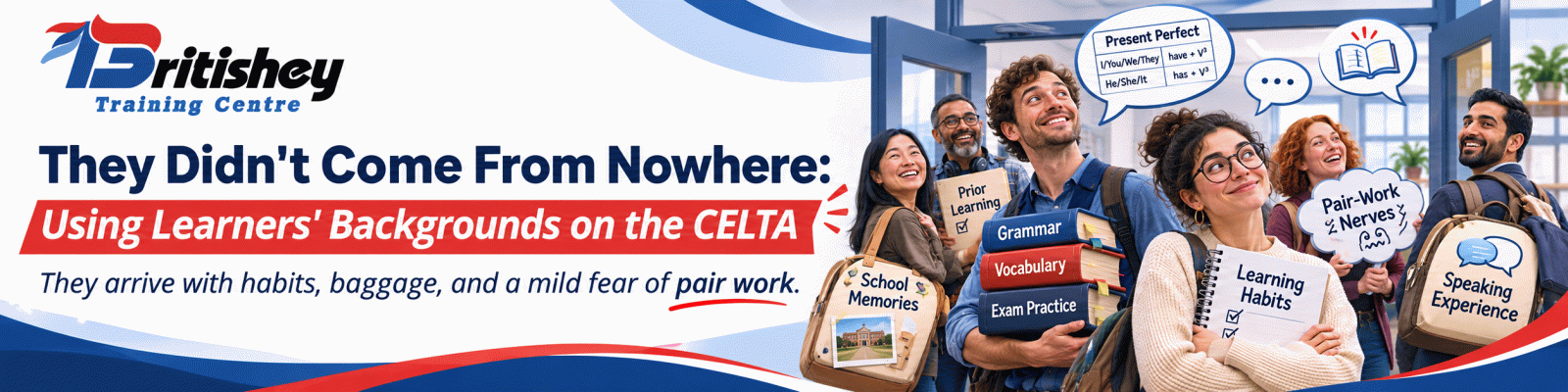
Here's something I say on every CELTA I tutor, whether it's in Cairo or Durban: your learners didn't walk into your classroom from nowhere. They bring years of school with them, a first language (sometimes two or three), favourite ways of learning, and a few habits their old teachers drilled into them. Some love a good grammar table. Some panic the moment you say "work in pairs". Some speak beautifully but write... let's say creatively.
One of the CELTA criteria asks you to acknowledge, when necessary, learners' backgrounds and previous learning experiences. It sounds a bit formal, but really it's about one simple thing: getting to know the people in front of you and letting that shape your lessons. Think of it as intelligence gathering. Your mission: find out who your learners are before you plan for them.
Why it matters (and what "when necessary" means)
Learners arrive with expectations about what a "proper" lesson looks like. If most of their schooling was teacher-fronted and exam-focused, a lovely communicative activity can fall flat, not because the activity is bad, but because nobody showed them why they're doing it or how. On the other hand, learners who've only ever "picked English up" might be fluent and confident but have never looked closely at form.
Now, the "when necessary" part is important. Nobody expects you to write a biography of every learner or to mention backgrounds at every stage of every lesson. It's about the moments when it makes a real difference:
- a learner who has never done a role play before
- a first-language feature that keeps causing the same error
- a mixed-nationality group where English is the only shared language
- a learner whose previous experience of being corrected in public was, well, not great
Your tutors will look for this in two places: in your plan (a learner profile that's specific and anticipated problems that are about these learners) and in the lesson itself (the choices you make on your feet).
1. Find out from learners and peers
From the learners themselves
- Getting-to-know-you activities on day one: find someone who, interviews, "two truths and a lie". Light, fun, and full of useful information.
- A short needs analysis questionnaire: Why are you learning English? Where have you studied before? What did you enjoy? What did you hate? Any exams coming up?
- Chat before class and in the break. Honestly, this is where you learn the most. Who's a nurse, who's preparing for IELTS, who's just moved to the city.
- Watch how they react. Who dives into pair work and who waits to be told the answer? Who looks for the grammar box on the page?
- Exit slips: one quick line at the end of the lesson. "What helped you most today?"
From your peers
This is the CELTA's secret weapon. You're in a TP group, and your peers taught the same learners yesterday and the day before. Use that!
- Read the learner profiles in your peers' plans.
- When you observe, take notes on the learners, not just the teacher: who works well together, who dominates, who goes quiet.
- Ask your peers straight after their lesson: "How did Ahmed cope with the listening?"
- Keep a shared group profile that everyone updates after each TP. It takes five minutes and saves everyone hours.
One gentle warning: ask, don't assume. Nationality, age or job tells you very little on its own. Two learners from the same country can have had completely different school experiences. And keep anything personal you learn respectful and professional.
2. Find out about their linguistic strengths and weaknesses
It's not just who they are; it's what they can and can't do yet with the language.
- Use a diagnostic task. A short speaking task, a quick piece of writing or a test-teach-test stage shows you very quickly what they already know.
- Keep an error log. During fluency activities, note real errors (and good language!) by learner. Patterns appear fast.
- Think about the first language. Some errors come straight from L1. Arabic speakers, for example, often find /p/ and /b/ tricky and may leave out be in the present ("He teacher"). Spanish speakers might say "I have 25 years". Michael Swan and Bernard Smith's Learner English is a brilliant reference for this.
- Look at the whole profile, not just the weaknesses. Fluent but inaccurate? Accurate but slow and hesitant? Strong readers but weak listeners? Great vocabulary but flat intonation? Each profile needs a different lesson.
Then put it in your plan. "Learners may find the past simple difficult" is too general. "Mona and Karim tend to drop the -ed ending in speaking, so I'll drill the /t/, /d/ and /ɪd/ endings and focus on them in feedback" is exactly what your tutor wants to see.
3. Use it to select materials and activity types
Once you know your learners, your choices stop being random and start being justified.
- Contexts that fit their lives. If the coursebook text is about skiing holidays and your group is mostly working adults who've never been near snow, adapt it or swap it for something closer to home. Keep the target language; change the wrapper.
- Build bridges from what they know. Learners from very teacher-centred backgrounds might need pair work introduced gradually: model it first, give clear instructions, check with ICQs, keep the first task short. You're not throwing out everything they're used to; you're bringing them along with you.
- A little of the familiar can reassure. A clear board record of the form or a short controlled practice can make learners who expect grammar feel safe enough to try the freer stuff.
- Target the real gaps. Fluent but inaccurate? Build in a focus on form. Accurate but quiet? More speaking time and more rehearsal. Weak listeners? Pre-teach key words and give a gist task before the detail.
- Pronunciation that matches their L1. Drill the sounds and features your learners actually struggle with.
In your plan, link each choice to the learners: "I chose a jigsaw reading because this group is confident in speaking but needs more reading practice, and it gives everyone a reason to talk."
4. Use it for pair work, group work and open class
Setting up pairs and groups
- Mix first languages where you can, so English becomes the natural choice.
- Mix or match levels on purpose. A stronger learner can support a weaker one in a reading task, but for a freer speaking task, similar levels can work better. Decide why before you decide who.
- Think about personalities. Separate the two who chat in L1 the whole time; don't put the quietest learner with the most dominant one for the first task of the day.
- Be sensitive and flexible. Some learners may feel more comfortable in certain groupings. Notice it, respect it, and don't make a big thing of it.
- Change pairs regularly so everyone hears different voices (and nobody gets stuck with the same partner for a month).
In open class
- Nominate thoughtfully. Don't put a shy learner on the spot first. Let them rehearse in pairs, then invite them to share.
- Use what they know. Learners' experience is a fantastic resource: "Lina, you work in a hospital. What would you say here?" Just avoid making anyone the spokesperson for their whole country.
- Correct with care. Some learners want every mistake corrected; others switch off if they feel exposed. Delayed, anonymous feedback on the board is often a kind and effective option.
- Use their names. Small thing, huge difference.
Your quick TP checklist
- My learner profile is specific and up to date (not copied from last week).
- My anticipated problems are about these learners, with clear solutions.
- I can explain why I chose these materials and activity types for this group.
- I've planned who works with whom, and why.
- I've thought about who I'll nominate in open class, and when.
- After the lesson: what did I learn about my learners today, and how will it change my next plan?
A final word
Good teaching isn't about delivering the same perfect lesson to any group in the world. It's about teaching this group, today. So ask that extra question, adapt that text, try that new grouping. He who dares... wins!
See you in TP,
Shady Abuyusuf
Comments
0No comments yet. Be the first to join the discussion.