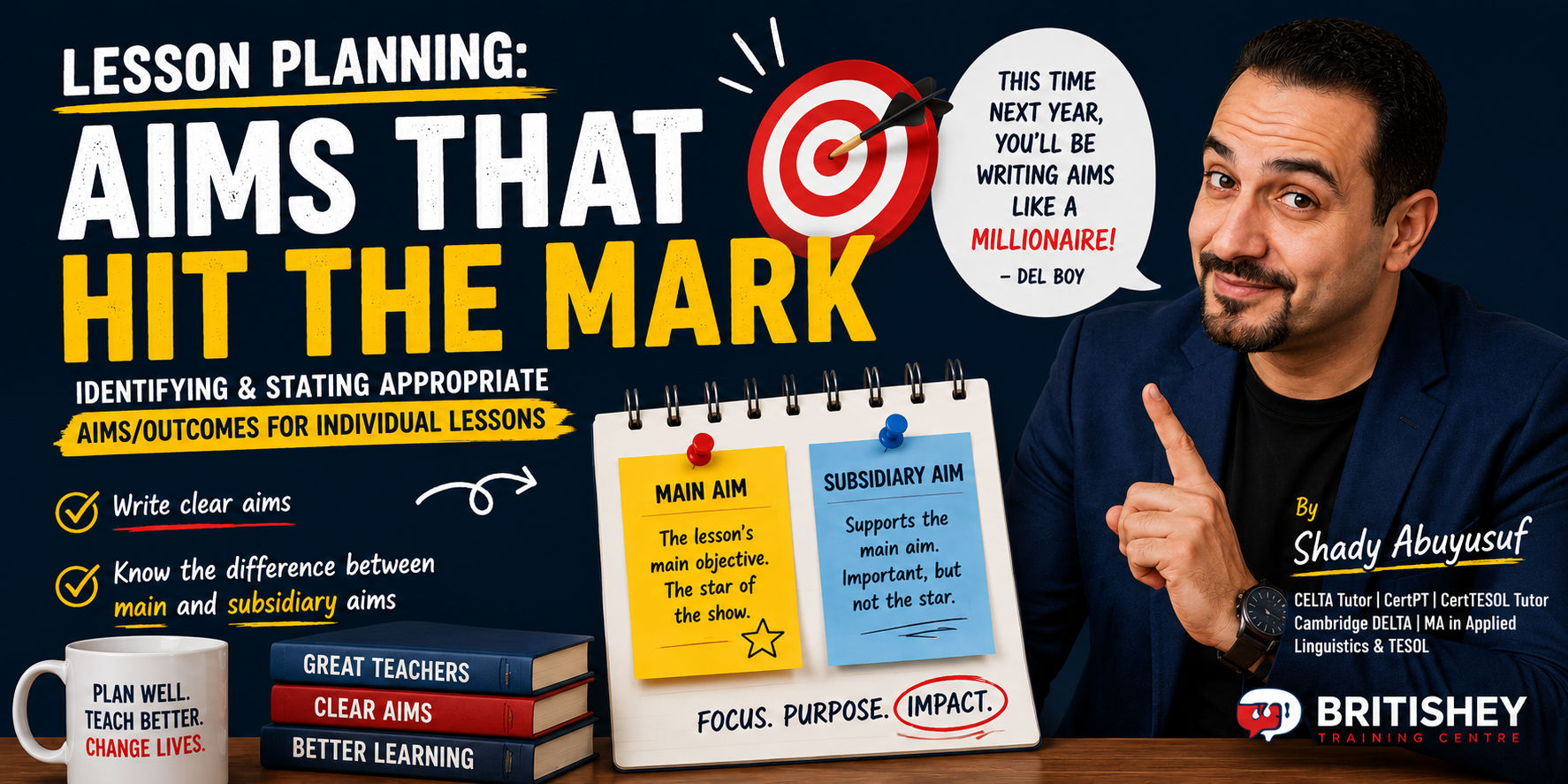
Planning a lesson without clear aims is a bit like getting into a taxi in Cairo and saying, “Just drive.” You may end up somewhere interesting, but it probably will not be where you needed to go. Lesson aims give your teaching direction, purpose and focus. They tell you what learners should be able to do by the end of the lesson, and they help you decide what to include, what to leave out and when to stop talking before your students start mentally emigrating.
For trainees on CELTA, CertTESOL, TEFL or any serious teacher-training course, writing clear lesson aims is not just a box to tick on the lesson plan. It is one of the most important planning skills a teacher can develop. A well-written aim shows that you know what your lesson is really about. A vague aim shows that you may be hoping the lesson will somehow work through educational magic. Computer says no.
What Are Lesson Aims?
A lesson aim is a clear statement of what you want learners to achieve by the end of the lesson.
It should answer this question:
By the end of the lesson, what will learners be better able to do?
Notice the wording: learners, not the teacher.
Aims are not about what you will teach. They are about what learners will learn, practise, improve or produce.
So, this is weak:
To teach present perfect.
This is better:
By the end of the lesson, learners will be better able to use the present perfect simple to talk about life experiences, e.g. I’ve visited London and I’ve never eaten sushi.
The first one tells us what the teacher plans to present. The second one tells us what the learners should be able to do with the language. Lovely jubbly.
Why Clear Aims Matter
Clear aims help teachers make better decisions before, during and after the lesson.
Before the lesson, aims help you choose appropriate materials, tasks and language focus. During the lesson, they help you manage time and avoid wandering into unnecessary explanations. After the lesson, they help you evaluate whether the lesson was successful.
For example, if your main aim is to help learners practise speaking fluently about past holidays, but you spend thirty minutes explaining the difference between journey, trip, travel and voyage, you may have taught some useful vocabulary, but you have not served the main aim. You have taken the scenic route and possibly lost half the passengers.
Clear aims also help observers, tutors and assessors understand the logic of your lesson. They can see whether your stages contribute to your intended outcome.
What Makes an Aim Clear?
A clear lesson aim should usually include:
- The skill or language area
- The specific focus
- The context or communicative purpose
- The expected learner outcome
Compare these two aims:
To improve reading.
This is far too general. Improve reading how? Reading what? Reading for what purpose? Reading bus tickets? Shakespeare? WhatsApp messages from your aunt?
A clearer version would be:
By the end of the lesson, learners will be better able to read a short travel blog for gist and specific information about holiday experiences.
This aim tells us the skill, text type, subskills and context.
For language lessons, avoid writing aims that are too broad:
To teach vocabulary.
Instead, specify the lexical area and use:
By the end of the lesson, learners will be better able to understand and use adjectives describing personality, such as reliable, generous and selfish, in the context of describing friends and family.
This gives the lesson a clear destination.
Main Aims and Subsidiary Aims: What Is the Difference?
This is where many trainee teachers get confused, so let’s make it clear.
The main aim is the central learning objective of the lesson. It is the main reason the lesson exists.
The subsidiary aim supports the main aim. It is not the star of the show; it is the supporting actor. Important, useful, but not the one whose name is on the poster.
Think of it like this:
- The main aim is the main course.
- The subsidiary aim is the side dish.
- The personal aim is what the chef is trying to improve while cooking.
And no, the side dish should not take over the whole meal. This is not Come Dine With Me.
Examples of Main and Subsidiary Aims
Example 1: Speaking Lesson
Main aim:
By the end of the lesson, learners will be better able to speak fluently about memorable holidays using appropriate sequencing expressions.
Subsidiary aim:
Learners will review and use lexical items related to travel and holidays, such as accommodation, sightseeing and local cuisine.
Here, the main aim is speaking fluency. The vocabulary supports the speaking task, but it is not the main focus.
Example 2: Reading Lesson
Main aim:
By the end of the lesson, learners will be better able to read a magazine article about healthy lifestyles for gist and specific information.
Subsidiary aim:
Learners will practise speaking by discussing their own lifestyle habits in response to the text.
In this case, the lesson is mainly about reading. The speaking stage gives learners a chance to respond personally to the topic, but it does not become the central aim.
Example 3: Grammar Lesson
Main aim:
By the end of the lesson, learners will be better able to use going to for future plans in the context of weekend arrangements.
Subsidiary aim:
Learners will practise listening for specific information in short conversations about weekend plans.
Here, the listening task may provide context or exposure to the target language, but the main aim is grammar use.
Common Mistakes When Writing Lesson Aims
One common mistake is writing aims that are too vague:
To develop students’ speaking.
This does not tell us enough. A better aim would specify the type of speaking and context:
By the end of the lesson, learners will be better able to give and justify opinions about online learning in a group discussion.
Another common mistake is writing teacher-centred aims:
To teach students vocabulary about food.
It is better to write:
By the end of the lesson, learners will be better able to understand and use vocabulary related to food preparation, such as boil, grill, slice and stir, when explaining a simple recipe.
A third mistake is confusing the main aim with the lesson procedure. For example:
To show students a video and ask questions.
That is not an aim. That is an activity. The real aim might be:
By the end of the lesson, learners will be better able to listen for specific details in a short video interview about work-life balance.
Activities are what learners do. Aims are why they do them.
Aims and Outcomes: Are They the Same?
They are closely related, but there is a useful distinction.
An aim states the teacher’s planned learning focus.
An outcome describes what learners should be able to demonstrate by the end of the lesson.
For example:
Aim:
To help learners use functional language for making polite requests in a workplace context.
Outcome:
By the end of the lesson, learners will be able to role-play workplace situations using phrases such as Could you possibly...?, Would you mind...? and I was wondering if...
In practical lesson planning, aims and outcomes often overlap. However, thinking in terms of outcomes makes your aim more measurable. If learners cannot demonstrate it, the aim may be too vague.
How to Write Strong Lesson Aims
A useful formula is:
By the end of the lesson, learners will be better able to + skill/language + specific focus + context/purpose.
For example:
By the end of the lesson, learners will be better able to write a short informal email inviting a friend to an event.
Or:
By the end of the lesson, learners will be better able to distinguish between and use must and have to to talk about rules and obligations.
Or:
By the end of the lesson, learners will be better able to listen to a short radio interview for gist and specific information about career changes.
This formula is not the only possible wording, but it helps keep the aim learner-centred, specific and measurable.
How Specific Should an Aim Be?
Specific enough for someone to understand exactly what the lesson is trying to achieve.
Not this:
To practise grammar.
This is so vague it could mean anything from the present simple to the third conditional, and that is a dangerous neighbourhood to wander into without a map.
Better:
By the end of the lesson, learners will be better able to use the second conditional to talk about imaginary situations, e.g. If I won the lottery, I’d travel around the world.
This tells us the grammar structure, the meaning/use and the context.
Checking Whether Your Aim Works
Before finalising your aim, ask yourself:
Can I observe this aim being achieved?
If the answer is no, rewrite it.
For example:
To make students understand the present perfect.
Understanding is difficult to observe directly. You need to connect it to performance:
By the end of the lesson, learners will be better able to ask and answer questions about life experiences using the present perfect simple, e.g. Have you ever ridden a horse?
Now the aim can be assessed through learner performance.
Also ask:
Does every major stage in my lesson support this aim?
If a stage does not support the main or subsidiary aim, you may need to remove it or rethink it. A lesson plan should not be a suitcase packed by someone who says, “I might need this.” No, you will not need three lead-ins, two videos, a crossword, a song and a role-play in a 45-minute lesson. I’m not bovvered how nice the activity is.
Main Aim vs Subsidiary Aim in Skills Lessons
In a skills lesson, the main aim usually focuses on one of the four skills: reading, listening, speaking or writing. However, you should make it more precise by identifying the subskill.
For example:
Reading
Weak:
To practise reading.
Strong:
By the end of the lesson, learners will be better able to read an online restaurant review for gist and specific information.
Listening
Weak:
To improve listening.
Strong:
By the end of the lesson, learners will be better able to listen to a short conversation between friends for attitude and specific details.
Speaking
Weak:
To practise speaking.
Strong:
By the end of the lesson, learners will be better able to take part in a short discussion giving opinions and agreeing/disagreeing politely.
Writing
Weak:
To write an email.
Strong:
By the end of the lesson, learners will be better able to write a short semi-formal email requesting information about a course.
The subsidiary aim in a skills lesson might focus on vocabulary, functional language, pronunciation, or another skill that supports the main task.
Main Aim vs Subsidiary Aim in Language Lessons
In a language lesson, the main aim usually focuses on grammar, vocabulary, functions or pronunciation.
For grammar, include the structure, meaning/use and context.
By the end of the lesson, learners will be better able to use the past simple regular and irregular forms to describe completed actions in a holiday story.
For vocabulary, include the lexical set and communicative purpose.
By the end of the lesson, learners will be better able to use vocabulary for describing films, such as plot, cast, scene and ending, when recommending a film.
For functions, include the communicative function and context.
By the end of the lesson, learners will be better able to make and respond to suggestions in the context of planning a weekend activity.
A subsidiary aim might focus on pronunciation, listening for examples of the language, or speaking practice using the target language.
Personal Aims Are Different
Many lesson plan templates also ask for personal aims. These are not learner aims. They are areas the teacher wants to improve in their own teaching.
For example:
To give clearer instructions using ICQs and demonstrations.
Or:
To reduce teacher talking time during feedback stages.
Or:
To monitor more systematically during pair work.
Do not confuse personal aims with lesson aims. A personal aim is about your development as a teacher. A lesson aim is about the learners’ development. Both matter, but they are not the same thing.
Final Thoughts
Clear lesson aims are not decorative. They are not there to make the lesson plan look professional while everyone secretly ignores them. They are the backbone of the lesson. They help you plan logically, teach with focus and evaluate learning more accurately.
A good lesson aim is learner-centred, specific, realistic and measurable. It tells us what learners should be able to do by the end of the lesson and keeps the teacher focused on learning rather than simply covering material.
The main aim is the heart of the lesson. The subsidiary aim supports it. If the subsidiary aim starts taking over, it is time to gently escort it back to its seat.
In teacher training, writing aims well is one of the clearest signs that a teacher is beginning to think professionally. It shows that you are not just asking, “What activity shall I do?” You are asking the much better question:
What learning do I want this activity to produce?
And once you start asking that question, your planning becomes sharper, your teaching becomes more purposeful and your learners get a much better deal.
To quote the spirit of Del Boy: this time next year, you’ll be writing lesson aims like a millionaire.


Comments
0